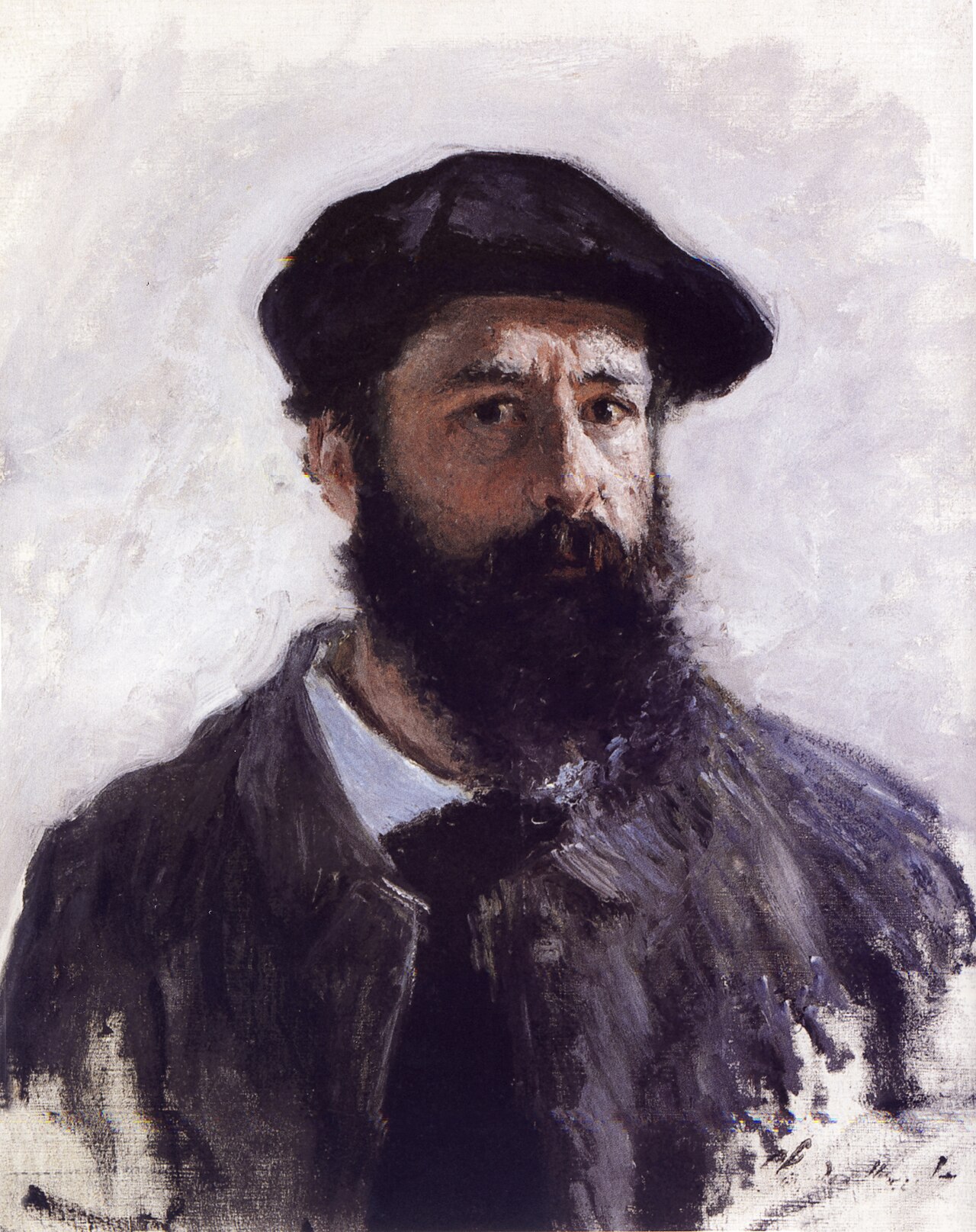
Claude Monet 1840–1926
Why would a painter paint the same haystack 25 times? Or the same pond about 250 times? Claude Monet spent sixty years chasing something that never stays still: light. To him, a cathedral at 8 a.m. and the same cathedral at 4 p.m. were two different paintings. Here is the story of the man who changed how the world looks at a picture, and how to see his work with new eyes.
How did a boy who drew cartoons become a great painter?
Monet was born in Paris in 1840 and grew up in Le Havre, a busy port on the Normandy coast. As a teenager he was famous in town for his caricatures, which he sold for a few francs each. The landscape painter Eugène Boudin saw them and took the young man outdoors to paint. Monet later said that from that day his eyes were opened.
Why did he carry his easel outside?
In the 1860s most artists painted in the studio. Monet carried his easel to beaches, gardens and riverbanks and worked quickly, with short strokes of pure colour, to catch the moment before the light changed. Critics found the paintings unfinished. Money was so short that he sometimes could not buy paint.
How did an insult name an art movement?
In 1874 Monet and his friends held their own exhibition in Paris. One of his pictures, a hazy harbour at dawn, was called Impression, Sunrise. A critic mocked the whole group as "Impressionists", and the name stuck. The insult became one of the most loved words in art history.
Why paint the same thing again and again?
From the 1880s Monet began painting series: haystacks, poplars, Rouen Cathedral and, later, the Houses of Parliament in London. He worked on many canvases at once and switched between them as the sun moved. The real subject was no longer the building or the field, but the air and light around it.
What made Giverny his greatest subject?
In 1883 Monet moved to Giverny, a village on the Seine. He dug a pond, planted water lilies and built a green Japanese bridge. For his last thirty years the garden was his studio. He painted the water lilies about 250 times, even as cataracts clouded his eyesight. He died at Giverny in 1926, aged 86.
How did Monet paint? His technique, step by step
Look closely at a Monet and the picture falls apart into hundreds of short, separate strokes. Step back and it comes together into water, sky or a field of poppies. That effect is the heart of his technique.
Broken colour. Instead of mixing colours smoothly on the palette, Monet laid small dabs of fairly pure colour side by side on the canvas, a blue next to a yellow, an orange next to a violet. Your eye mixes them from a distance, and the colours look brighter and more alive than a flat mix would.
Coloured shadows, almost no black. The old masters painted shadows dark brown or black. Monet painted them blue, violet and green, because in sunlight that is what shadows really look like. In his mature work he largely gave up black paint and made his darks from other colours.
Wet into wet, and fast. Working outdoors, he often put new paint onto paint that was still wet. Edges soften and colours blend a little on the canvas itself. Speed mattered: the light could change in minutes, so he sometimes kept a canvas for each hour and switched between them.
Thick paint you can feel. Many strokes stand up from the surface (impasto). In sunlight on the real canvas they catch light and give the picture its shimmer.
New colours from the tube. Modern pigments let him paint with clean, strong colour. Studies of his late Water Lilies by the National Gallery in London and the Art Institute of Chicago found cobalt blue, French ultramarine, viridian green, cobalt violet, cadmium yellows and vermilion. He preferred ready-made cobalt violet to mixing purple from red and blue.
How to spot a Monet
- Short, visible brushstrokes instead of smooth, polished surfaces
- Shadows painted in blue or violet, not black
- Water, sky and weather as the real subject: mist, fog, sunsets, reflections
- Soft edges, as if the scene is seen in a quick glance
- Often part of a series: the same place painted in different light
Famous paintings by Claude Monet
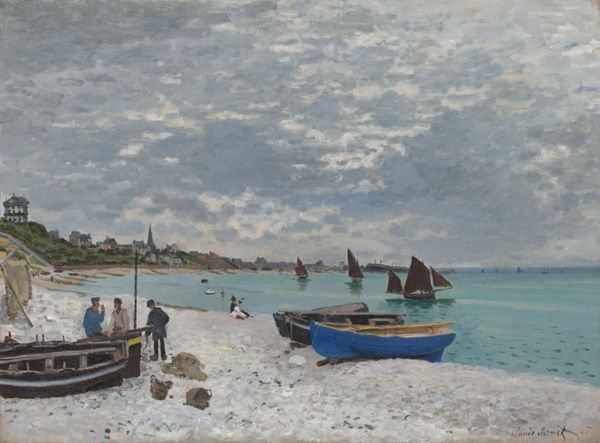
A breezy summer day on the Normandy coast where Monet grew up. The fishing boats and bright sky show his early love of open air.
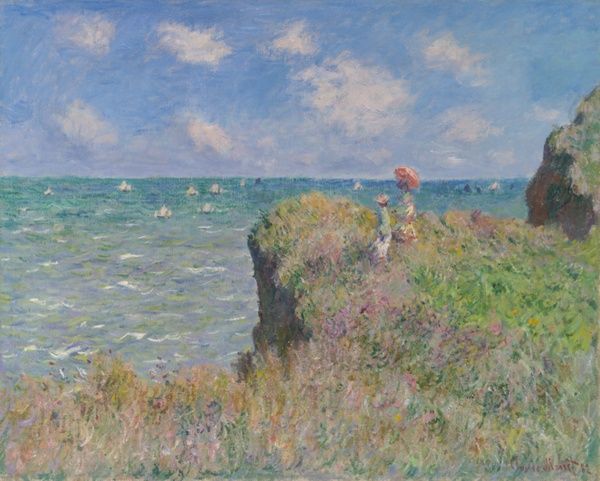
Two small figures on a clifftop, almost lost in wind, grass and sea. The quick strokes make you feel the weather.
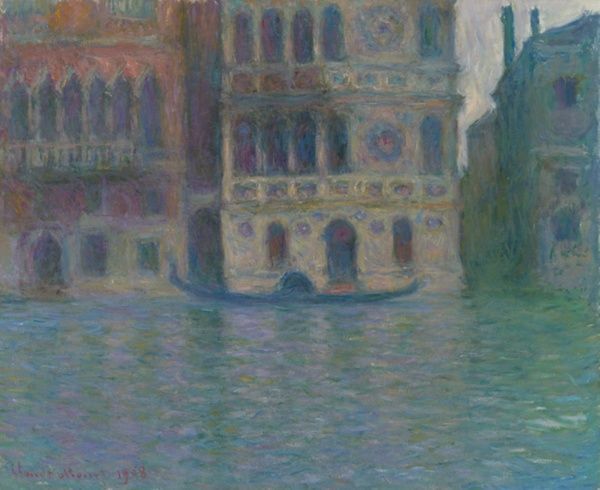
A palace on the Grand Canal, painted on his only trip to Venice in 1908, when he was nearly seventy.
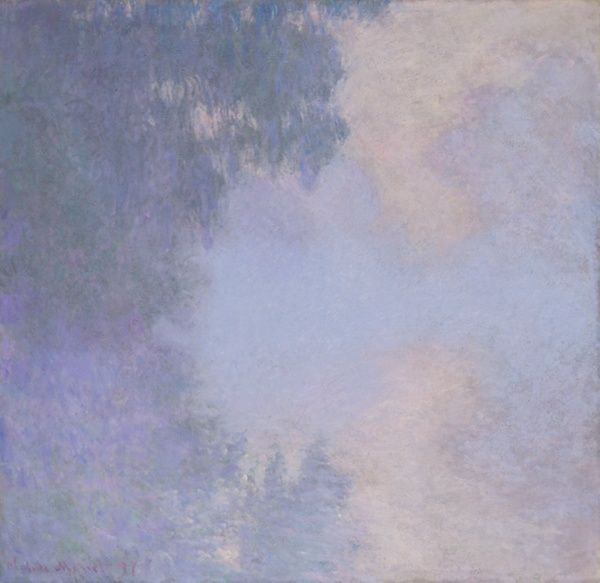
Part of his "Mornings on the Seine" series. Monet started work before dawn to catch the river while the mist was still rising.
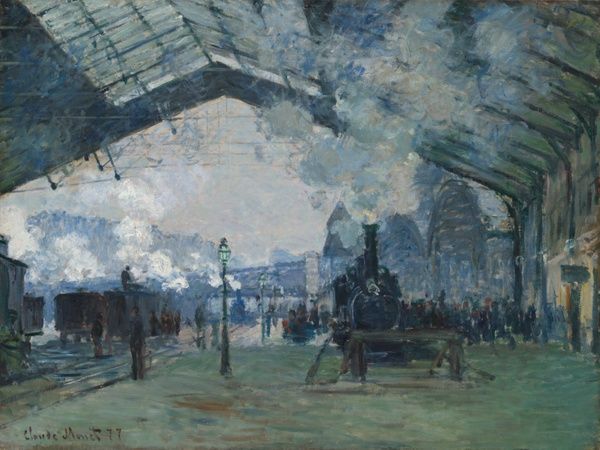
Monet rented a small studio near the Paris railway station and painted the steam and glass roof again and again. Trains were the new modern subject.
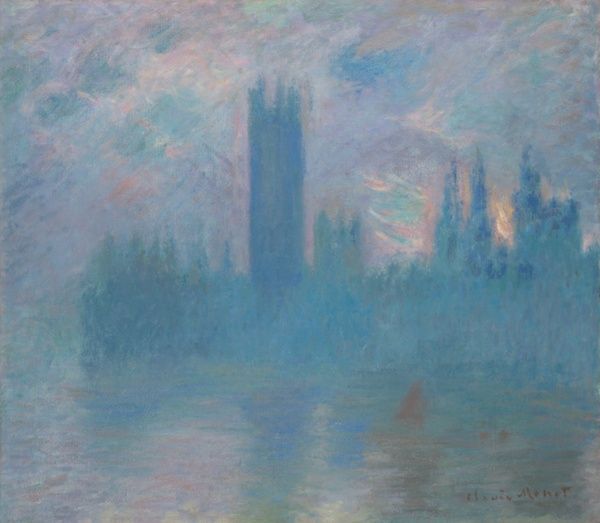
Painted from a hospital window across the Thames. London fog fascinated Monet: he said that without it, London would not be beautiful.
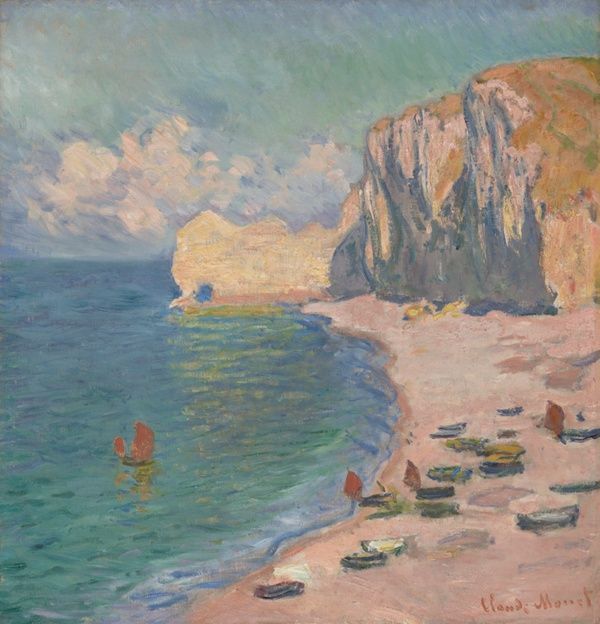
The famous rock arches of Étretat, painted on a stormy coast he visited many times in the 1880s.
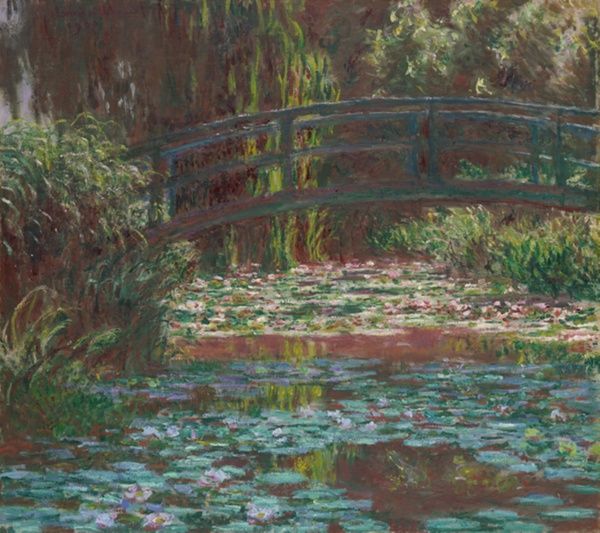
His own pond at Giverny with the Japanese footbridge. The garden he built became the great subject of his last decades.
Did you know?
- Monet earned his first real money from caricatures, not landscapes.
- He painted around 30 views of Rouen Cathedral at different times of day.
- His giant water lily murals were given to France after the First World War and still fill two oval rooms at the Musée de l'Orangerie in Paris.
Frequently asked questions
What is Claude Monet's most famous painting?
Two answers are usually given. Impression, Sunrise (1872) is the most important, because it gave Impressionism its name. The Water Lilies are the most loved: Monet painted his pond at Giverny about 250 times over some thirty years.
How many paintings did Monet make?
Nobody knows the exact number, but it is usually put at around 2,000 paintings over a career of about sixty years, plus drawings and pastels. Many of them belong to series of the same subject painted in different light.
Where is Impression, Sunrise today?
It hangs in the Musée Marmottan Monet in Paris, which has the largest collection of Monet's work in the world. Monet painted it in the harbour of Le Havre, the town where he grew up.
Where can I see Monet's paintings?
In Paris, the Musée Marmottan Monet, the Musée d'Orsay and the Musée de l'Orangerie (home of the giant Water Lilies). Outside France, large groups of his paintings are in the Art Institute of Chicago, the Metropolitan Museum of Art in New York and the National Gallery in London. His house and garden at Giverny are open to visitors from spring to autumn.
Did Monet go blind?
Not completely, but cataracts badly damaged his sight. He was diagnosed in 1912, and colours slowly looked browner and muddier to him. In 1923 he finally had surgery on one eye. When he could see clearly again he was unhappy with some late canvases and repainted them in brighter colours.
What is the most expensive Monet ever sold?
Meules (Haystacks), painted in 1890, sold at Sotheby's in New York in May 2019 for $110.7 million. It was the first Impressionist painting to sell for more than $100 million at auction.
Why did Monet paint the same subject so many times?
Because for him the subject was the light, not the object. A haystack at sunrise, at noon and under snow looks completely different, so each version is a new painting. He would set up several canvases and move from one to the next as the sun moved.
What is the difference between Monet and Manet?
They were friends with very similar names. Édouard Manet (1832–1883) painted city life and people in strong, dark contrasts and shocked Paris with Olympia. Claude Monet (1840–1926) painted landscapes and water in light, broken colour and led the Impressionists.
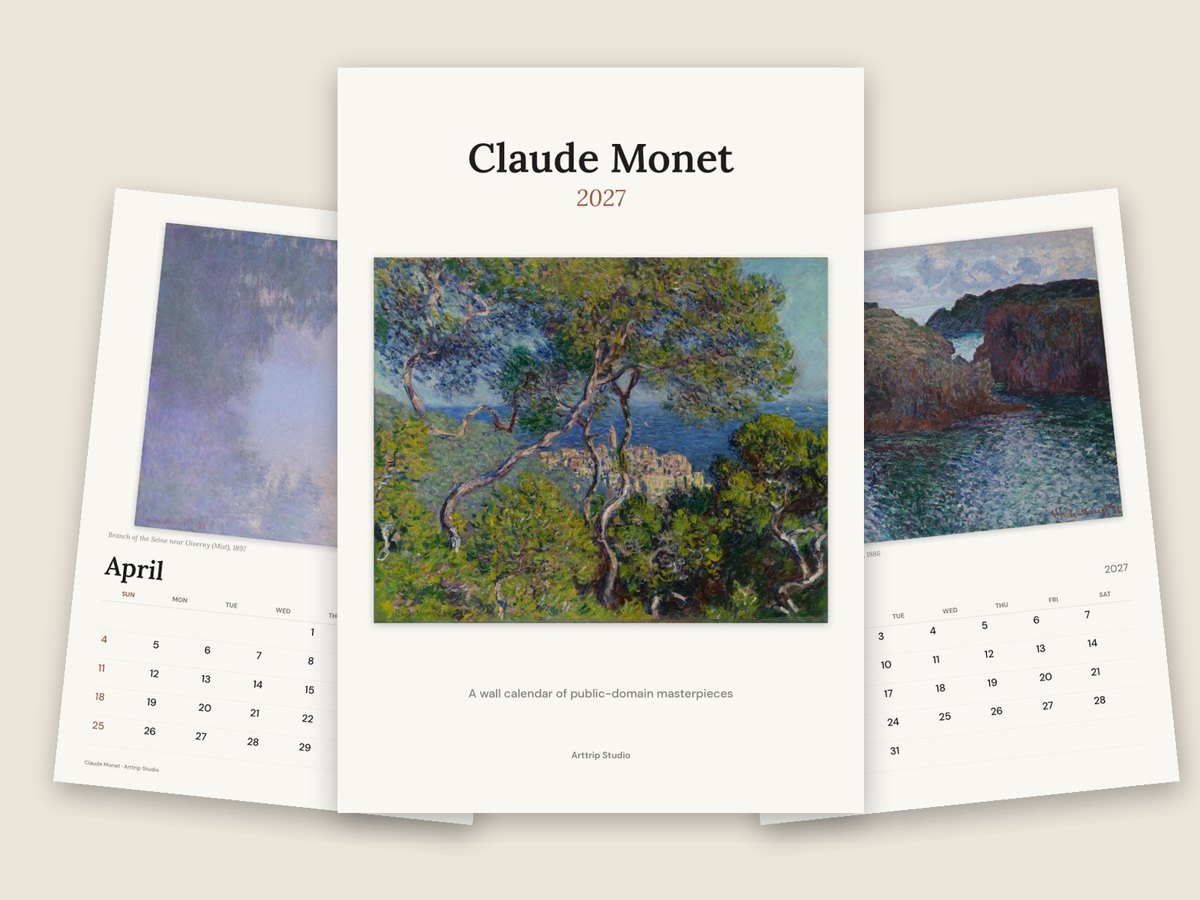
Claude Monet 2027 Wall Calendar
Twelve masterpieces by Claude Monet, one for every month. A4 + US Letter PDF.
See the calendar · $6.5